Monday, June 29, 2015
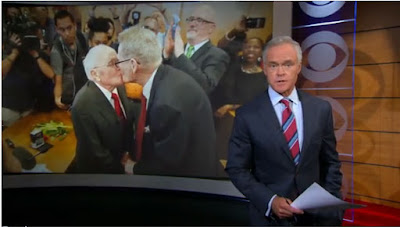
CBS Evening News Coverage of SupCt Decision
Click the pic to watch the video of the June 26, 2015 CBS Evening News with extensive coverage of the Supreme Court's same-sex marriage ruling, plus anchor Scott Pelley's commentary on "A week for equality" at about 20:32.


Pres Obama Speaks on SupCt Ruling
Click the pic to watch the video of the President's statement lauding the Supreme Court decision that same-sex marriage is legal under the US Constitution.

UN SecGen Lauds US SupCt Ruling
"The Secretary-General welcomes the decision of the Supreme Court that paves the way for gay and lesbian Americans to have their relationships legally recognized, no matter what part of the country they live in. In an interview just now, he called it a great step forward for human rights. He is a strong believer in equality and in the equal worth and
dignity of LGBTQ people. Denying couples legal recognition of their relationship opens the door to widespread discrimination. This ruling will help close that door and marks a great step forward for human rights in the United States. He joins the LGBTQ community and its millions of allies in celebrating this historic decision."
From the daily briefing by Farhan Haq, Deputy Spokesman for United Nations Secretary-General Ban Ki-moon, June 26, 2015.
From the daily briefing by Farhan Haq, Deputy Spokesman for United Nations Secretary-General Ban Ki-moon, June 26, 2015.
Friday, June 26, 2015
Supreme Court Rules For Same-Sex Marriage/Marriage Equality !!!
Syllabus
"Held: The Fourteenth Amendment requires a State to license a marriage between two people of the same sex and to recognize a marriage between two people of the same sex when their marriage was lawfully licensed and performed out-of-State...
... The right to marry is a fundamental right inherent in the liberty of the person, and under the Due Process and Equal Protection Clauses of the Fourteenth Amendment couples of the same-sex may not be deprived of that right and that liberty. Same-sex couples may exercise the fundamental right to marry. Baker v. Nelson is overruled. The State laws challenged by the petitioners in these cases are held invalid to the extent they exclude same-sex couples from civil marriage on the same terms and conditions as opposite-sex couples...
... The Fourteenth Amendment requires States to recognize same-sex marriages validly performed out of State. Since same-sex couples may now exercise the fundamental right to marry in all States, there is no lawful basis for a State to refuse to recognize a lawful same-sex marriage performed in another State on the ground of its same-sex character."
Opinion
"... The limitation of marriage to opposite-sex couples may long have seemed natural and just, but its inconsistency with the central meaning of the fundamental right to marry is now manifest. With that knowledge must come the recognition that laws excluding same-sex couples from he marriage right impose stigma and injury of the kind prohibited by our basic charter...
Under the Constitution, same-sex couples seek in marriage the same legal treatment as opposite-sex couples, and it would disparage their choices and diminish their personhood to deny them this right.
The right of same-sex couples to marry that is part of the liberty promised by the Fourteenth Amendment is derived, too, from that Amendment’s guarantee of the equal protection of the laws. The Due Process Clause and the Equal Protection Clause are connected in a profound way, though they set forth independent principles. Rights implicit in liberty and rights secured by equal protection may rest on different precepts and are not always co-extensive, yet in some instances each may be instructive as to the meaning and reach of the other... This interrelation of the two principles furthers our understanding of what freedom is and must become...
... [Lawrence v. Texas] drew upon principles of liberty and equality to define and protect the rights of gays and lesbians, holding the State “cannot demean their existence or control their destiny by making their private sexual conduct a crime."
This dynamic also applies to same-sex marriage. It is now clear that the challenged laws burden the liberty of same-sex couples, and it must be further acknowledged that they abridge central precepts of equality. Here the marriage laws enforced by the respondents are in essence unequal: same-sex couples are denied all the benefits afforded to opposite-sex couples and are barred from exercising a fundamental right. Especially against a long history of disapproval of their relationships, this denial to same-sex couples of the right to marry works a grave and continuing harm. The imposition of this disability on gays and lesbians serves to disrespect and subordinate them. And the Equal Protection Clause, like the Due Process Clause, prohibits this unjustified infringement of the fundamental right to marry...
These considerations lead to the conclusion that the right to marry is a fundamental right inherent in the liberty of the person, and under the Due Process and Equal Protection Clauses of the Fourteenth Amendment couples of the same-sex may not be deprived of that right and that liberty. The Court now holds that same-sex couples may exercise the fundamental right to marry. No longer may this liberty be denied to them. Baker v. Nelson must be and now is overruled, and the State laws challenged by Petitioners in these cases are now held invalid to the extent they exclude same-sex couples from civil marriage on the same terms and conditions as opposite-sex couples.
... The dynamic of our constitutional system is that individuals need not await legislative action before asserting a fundamental right. The Nation’s courts are open to injured individuals who come to them to vindicate their own direct, personal stake in our basic charter. An individual can invoke a right to constitutional protection when he or she is harmed, even if the broader public disagrees and even if the legislature refuses to act. The idea of the Constitution “was to withdraw certain subjects from the vicissitudes of political controversy, to place them beyond the reach of majorities and officials and to establish them as legal principles to be applied by the courts.” West Virginia Bd. of Ed. v. Barnette... This is why “fundamental rights may not be submitted to a vote; they depend on the outcome of no elections."...
... The Court, in this decision, holds same-sex couples may exercise the fundamental right to marry in all States. It follows that the Court also must hold - and it now does hold - that there is no lawful basis for a State to refuse to recognize a lawful same-sex marriage performed in another State on the ground of its same-sex character.
No union is more profound than marriage, for it embodies the highest ideals of love, fidelity, devotion, sacrifice, and family. In forming a marital union, two people become something greater than once they were. As some of the petitioners in these cases demonstrate, marriage embodies a love that may endure even past death. It would misunderstand these men and women to say they disrespect the idea of marriage. Their plea is that they do respect it, respect it so deeply that they seek to find its fulfillment for themselves. Their hope is not to be condemned to live in loneliness, excluded from one of civilization’s oldest institutions. They ask for equal dignity in the eyes of the law. The Constitution grants them that right. The judgment of the Court of Appeals for the Sixth Circuit is reversed. "
"It is so ordered."
KENNEDY,J., delivered the opinion of the Court, in which GINSBURG, BREYER, SOTOMAYOR, and KAGAN, JJ., joined; (Obergefell et al. v. Hodges et al.) June 26, 2015.
CLICK HERE TO READ THE ENTIRE DECISION
"Held: The Fourteenth Amendment requires a State to license a marriage between two people of the same sex and to recognize a marriage between two people of the same sex when their marriage was lawfully licensed and performed out-of-State...
... The right to marry is a fundamental right inherent in the liberty of the person, and under the Due Process and Equal Protection Clauses of the Fourteenth Amendment couples of the same-sex may not be deprived of that right and that liberty. Same-sex couples may exercise the fundamental right to marry. Baker v. Nelson is overruled. The State laws challenged by the petitioners in these cases are held invalid to the extent they exclude same-sex couples from civil marriage on the same terms and conditions as opposite-sex couples...
... The Fourteenth Amendment requires States to recognize same-sex marriages validly performed out of State. Since same-sex couples may now exercise the fundamental right to marry in all States, there is no lawful basis for a State to refuse to recognize a lawful same-sex marriage performed in another State on the ground of its same-sex character."
Opinion
"... The limitation of marriage to opposite-sex couples may long have seemed natural and just, but its inconsistency with the central meaning of the fundamental right to marry is now manifest. With that knowledge must come the recognition that laws excluding same-sex couples from he marriage right impose stigma and injury of the kind prohibited by our basic charter...
Under the Constitution, same-sex couples seek in marriage the same legal treatment as opposite-sex couples, and it would disparage their choices and diminish their personhood to deny them this right.
The right of same-sex couples to marry that is part of the liberty promised by the Fourteenth Amendment is derived, too, from that Amendment’s guarantee of the equal protection of the laws. The Due Process Clause and the Equal Protection Clause are connected in a profound way, though they set forth independent principles. Rights implicit in liberty and rights secured by equal protection may rest on different precepts and are not always co-extensive, yet in some instances each may be instructive as to the meaning and reach of the other... This interrelation of the two principles furthers our understanding of what freedom is and must become...
... [Lawrence v. Texas] drew upon principles of liberty and equality to define and protect the rights of gays and lesbians, holding the State “cannot demean their existence or control their destiny by making their private sexual conduct a crime."
This dynamic also applies to same-sex marriage. It is now clear that the challenged laws burden the liberty of same-sex couples, and it must be further acknowledged that they abridge central precepts of equality. Here the marriage laws enforced by the respondents are in essence unequal: same-sex couples are denied all the benefits afforded to opposite-sex couples and are barred from exercising a fundamental right. Especially against a long history of disapproval of their relationships, this denial to same-sex couples of the right to marry works a grave and continuing harm. The imposition of this disability on gays and lesbians serves to disrespect and subordinate them. And the Equal Protection Clause, like the Due Process Clause, prohibits this unjustified infringement of the fundamental right to marry...
These considerations lead to the conclusion that the right to marry is a fundamental right inherent in the liberty of the person, and under the Due Process and Equal Protection Clauses of the Fourteenth Amendment couples of the same-sex may not be deprived of that right and that liberty. The Court now holds that same-sex couples may exercise the fundamental right to marry. No longer may this liberty be denied to them. Baker v. Nelson must be and now is overruled, and the State laws challenged by Petitioners in these cases are now held invalid to the extent they exclude same-sex couples from civil marriage on the same terms and conditions as opposite-sex couples.
... The dynamic of our constitutional system is that individuals need not await legislative action before asserting a fundamental right. The Nation’s courts are open to injured individuals who come to them to vindicate their own direct, personal stake in our basic charter. An individual can invoke a right to constitutional protection when he or she is harmed, even if the broader public disagrees and even if the legislature refuses to act. The idea of the Constitution “was to withdraw certain subjects from the vicissitudes of political controversy, to place them beyond the reach of majorities and officials and to establish them as legal principles to be applied by the courts.” West Virginia Bd. of Ed. v. Barnette... This is why “fundamental rights may not be submitted to a vote; they depend on the outcome of no elections."...
... The Court, in this decision, holds same-sex couples may exercise the fundamental right to marry in all States. It follows that the Court also must hold - and it now does hold - that there is no lawful basis for a State to refuse to recognize a lawful same-sex marriage performed in another State on the ground of its same-sex character.
No union is more profound than marriage, for it embodies the highest ideals of love, fidelity, devotion, sacrifice, and family. In forming a marital union, two people become something greater than once they were. As some of the petitioners in these cases demonstrate, marriage embodies a love that may endure even past death. It would misunderstand these men and women to say they disrespect the idea of marriage. Their plea is that they do respect it, respect it so deeply that they seek to find its fulfillment for themselves. Their hope is not to be condemned to live in loneliness, excluded from one of civilization’s oldest institutions. They ask for equal dignity in the eyes of the law. The Constitution grants them that right. The judgment of the Court of Appeals for the Sixth Circuit is reversed. "
"It is so ordered."
KENNEDY,J., delivered the opinion of the Court, in which GINSBURG, BREYER, SOTOMAYOR, and KAGAN, JJ., joined; (Obergefell et al. v. Hodges et al.) June 26, 2015.
CLICK HERE TO READ THE ENTIRE DECISION

Thursday, May 28, 2015
UN Head Lauds Irish Vote
“… And of course, Ireland has just become the first country to
grant same-sex marital rights through a national referendum. I was
not here at Dublin Castle on Saturday night, but I saw the pictures
of the jubilant crowd that gathered outside when the official count
was announced. And I listened to interviews in which several people
talked movingly about their experiences with bullying, discrimination
and life in the shadows.
Ireland voted on marriage, but in the process you have also decided to fully include members of the LGBT [lesbian, gay, bisexual and transgender] community in the life of this nation. The United Nations will continue to speak out, including through the Free & Equal campaign. You don’t have to be LGBT to care about LGBT rights; you only have to care about equality, fairness and human dignity. Those values are certainly part of the Irish identity.
As Secretary-General, from day one, I have declared that I will make the United Nations the best workplace for LGBT people to work. At that time, these people were working in the shadows. They were very cautious. When I invited the representatives of LGBT staff, they refused to take a picture with me. They were the first in the world who refused to take a picture with me - you’d be surprised. Everybody wants to take a picture with me! I asked why? Why are you afraid? [They said] because our photos will be put on a website. They didn’t want to be identified. So I agreed. I promised that I will keep the photo to myself and I’d only give it to [them] without publicizing it. As time went by, because they were encouraged, they made a calendar - a 12-page calendar, one year - putting in their photos with me. Every month, there were different photos. So they feel that their rights and human dignity are protected. Now for the first time again this last year I changed my administrative bulletin that those same-sex married couples will be given the same financial entitlements. That was historic. You may not know how hard I [fought]. There was serious fighting within the General Assembly. Some Member States submitted a draft resolution to reverse, to kill my decision. Their argument was that I was acting beyond my own authority. Fortunately, that resolution was defeated by the majority of the Member States. In fact, I did this first before you had your national referendum! So I’m proud that the United Nations is leading this campaign.”
United Nations Secretary-General Ban Ki-moon, May 25, 2015.
Ireland voted on marriage, but in the process you have also decided to fully include members of the LGBT [lesbian, gay, bisexual and transgender] community in the life of this nation. The United Nations will continue to speak out, including through the Free & Equal campaign. You don’t have to be LGBT to care about LGBT rights; you only have to care about equality, fairness and human dignity. Those values are certainly part of the Irish identity.
As Secretary-General, from day one, I have declared that I will make the United Nations the best workplace for LGBT people to work. At that time, these people were working in the shadows. They were very cautious. When I invited the representatives of LGBT staff, they refused to take a picture with me. They were the first in the world who refused to take a picture with me - you’d be surprised. Everybody wants to take a picture with me! I asked why? Why are you afraid? [They said] because our photos will be put on a website. They didn’t want to be identified. So I agreed. I promised that I will keep the photo to myself and I’d only give it to [them] without publicizing it. As time went by, because they were encouraged, they made a calendar - a 12-page calendar, one year - putting in their photos with me. Every month, there were different photos. So they feel that their rights and human dignity are protected. Now for the first time again this last year I changed my administrative bulletin that those same-sex married couples will be given the same financial entitlements. That was historic. You may not know how hard I [fought]. There was serious fighting within the General Assembly. Some Member States submitted a draft resolution to reverse, to kill my decision. Their argument was that I was acting beyond my own authority. Fortunately, that resolution was defeated by the majority of the Member States. In fact, I did this first before you had your national referendum! So I’m proud that the United Nations is leading this campaign.”
United Nations Secretary-General Ban Ki-moon, May 25, 2015.
Monday, May 25, 2015
Ireland Votes For Same-Sex Marriage
"Today Ireland made history.
The first country in the world to vote for equal marriage. I welcome that and thank all those who voted yesterday. In the privacy of the ballot box they made a public statement.
With today's Yes vote we have disclosed who we are - a generous, compassionate, bold and joyful people.
Yes to inclusion.
Yes to generosity.
Yes to love, and
Yes to equal marriage.
I know that for tens of thousands of couples and their families, the past 24 hours were almost a vigil at the end of a long journey. Would their fragile and deeply personal hopes be realised?
Would a majority of people, in this our Republic, stand with them and stand up for them so that they can live in our shelter and no longer in our shadow?
That having come out to us we could now come out for them - and do it with a single word, a solitary syllable - Yes - marked with an X.
Today they have their answer. The people have answered the call of families and friends, of neighbours and new acquaintances.
Of Jack O’Rourke and Edel Tierney, Finian Curran and Allie Kershaw and Jerry, Leo, Pat and so many others. It was their stories and their voices that inspired the hearts and minds of the Irish people.
Our people have truly answered Ireland's Call.
The referendum was about inclusiveness and equality, about love and commitment being enshrined in the constitution. For a significant proportion who voted against the amendment it was because of genuinely held views which are to be respected.
The decision makes every citizen equal and will strengthen the institution of marriage for all existing and future marriages. All people now have an equal future to look forward to.
So – the people went to the polls.
It passed.
The answer is YES.
Yes to their future.
Yes to their love.
Yes to their equal marriage.
That yes is heard loudly across the living world as a sound of pioneering leadership of our people and hopefully across the generations of gay men and women born as we say, before their time.
The people have spoken.
They have said yes.
Ireland – thank you."
Taoiseach Enda Kenny (Irish Leader), May 23, 2015.
The first country in the world to vote for equal marriage. I welcome that and thank all those who voted yesterday. In the privacy of the ballot box they made a public statement.
With today's Yes vote we have disclosed who we are - a generous, compassionate, bold and joyful people.
Yes to inclusion.
Yes to generosity.
Yes to love, and
Yes to equal marriage.
I know that for tens of thousands of couples and their families, the past 24 hours were almost a vigil at the end of a long journey. Would their fragile and deeply personal hopes be realised?
Would a majority of people, in this our Republic, stand with them and stand up for them so that they can live in our shelter and no longer in our shadow?
That having come out to us we could now come out for them - and do it with a single word, a solitary syllable - Yes - marked with an X.
Today they have their answer. The people have answered the call of families and friends, of neighbours and new acquaintances.
Of Jack O’Rourke and Edel Tierney, Finian Curran and Allie Kershaw and Jerry, Leo, Pat and so many others. It was their stories and their voices that inspired the hearts and minds of the Irish people.
Our people have truly answered Ireland's Call.
The referendum was about inclusiveness and equality, about love and commitment being enshrined in the constitution. For a significant proportion who voted against the amendment it was because of genuinely held views which are to be respected.
The decision makes every citizen equal and will strengthen the institution of marriage for all existing and future marriages. All people now have an equal future to look forward to.
So – the people went to the polls.
It passed.
The answer is YES.
Yes to their future.
Yes to their love.
Yes to their equal marriage.
That yes is heard loudly across the living world as a sound of pioneering leadership of our people and hopefully across the generations of gay men and women born as we say, before their time.
The people have spoken.
They have said yes.
Ireland – thank you."
Taoiseach Enda Kenny (Irish Leader), May 23, 2015.
Subscribe to:
Posts (Atom)